|
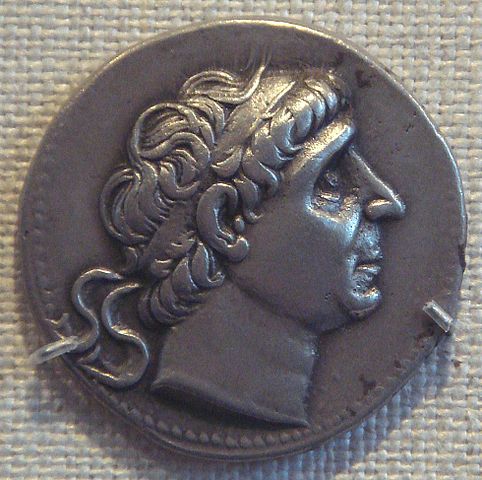
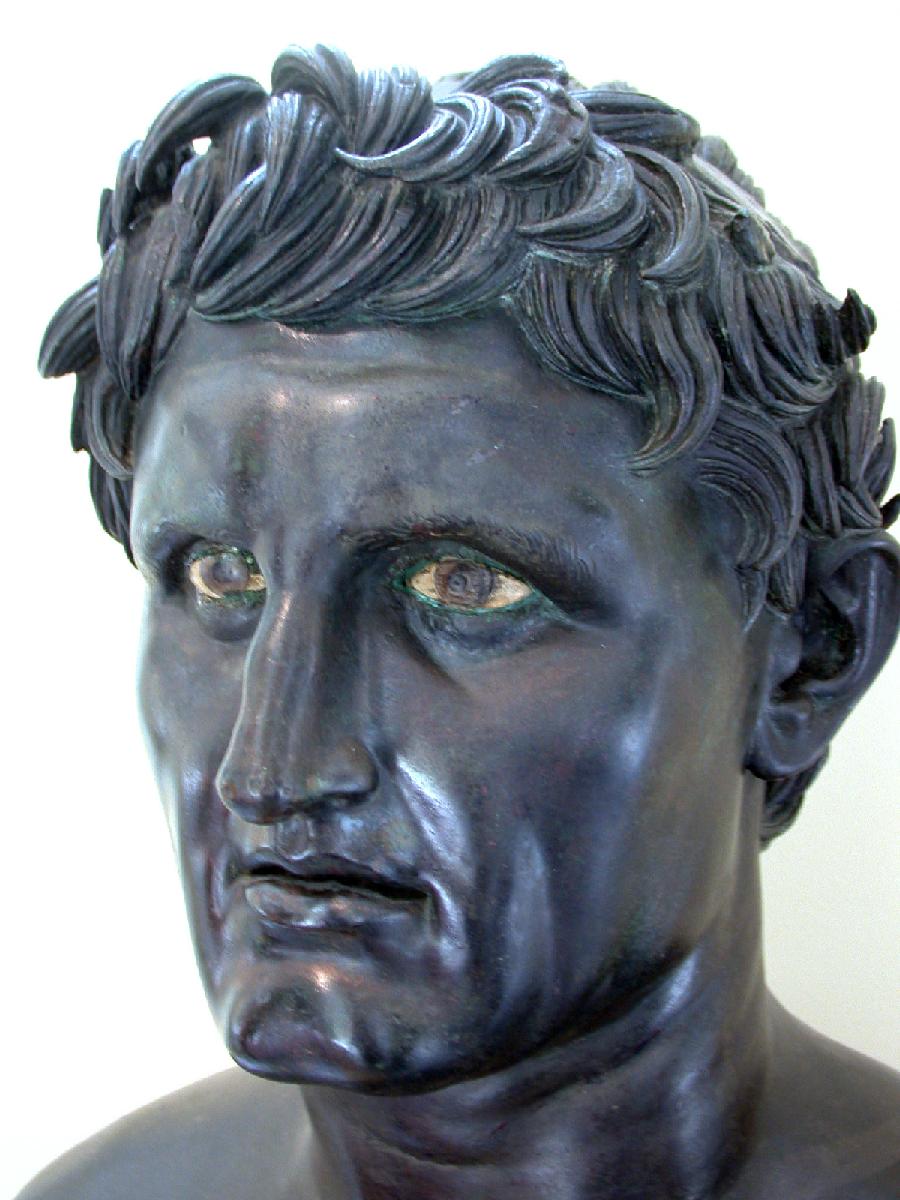 Seleucus Nicator (312-281).
In the division of Alexander's Empire, infantry General Seleucus
Nicator would receive the largest section of the empire, approximately
the equivalent of the former Persian Empire … and all the problems that
went with it. Locating his own capital at Babylon in 305 BC,
Seleucus ruled Anatolia, Syria and Palestine, Mesopotamia, Persia,
Kuwait, Bactria (Afghanistan and Turkmenistan), and parts of what is
today Pakistan. However when Seleucus ran into serious opposition
in the eastern reaches of his empire from the Indian general
Chandragupta Maurya,1 he
entered into alliance with Chandragupta, handing over to him not only
much of the far eastern portions of the Empire (Afghanistan and
Pakistan) but also his daughter in marriage … receiving 500 elephants
in return – which Seleucus subsequently used to great advantage in his
battles elsewhere. Seleucus Nicator (312-281).
In the division of Alexander's Empire, infantry General Seleucus
Nicator would receive the largest section of the empire, approximately
the equivalent of the former Persian Empire … and all the problems that
went with it. Locating his own capital at Babylon in 305 BC,
Seleucus ruled Anatolia, Syria and Palestine, Mesopotamia, Persia,
Kuwait, Bactria (Afghanistan and Turkmenistan), and parts of what is
today Pakistan. However when Seleucus ran into serious opposition
in the eastern reaches of his empire from the Indian general
Chandragupta Maurya,1 he
entered into alliance with Chandragupta, handing over to him not only
much of the far eastern portions of the Empire (Afghanistan and
Pakistan) but also his daughter in marriage … receiving 500 elephants
in return – which Seleucus subsequently used to great advantage in his
battles elsewhere.
But
much territory still remained to the new Seleucid dynasty that he
established. And into this land the Greeks migrated in large
numbers, bringing their language and culture ... leaving a permanent
mark on Central and West Asia that would only be replaced very slowly
by a return of the pre Greek cultures (but much changed through Greek
influence).
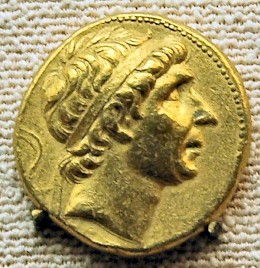  Seleucus'
son and grandson, Antiochus I (281-261 BC) and Antiochus II (261-246 BC), faced constant
challenges in the West as well – from the Egyptian Ptolemies and the
Celts (Gauls or Galatians) who were migrating into Asia Minor.
This ended up distracting Antiochus II so much that he lost control of
the satrapies of Bactria and Sogdiana (Afghanistan and
Turkmenistan) ... which however moved to independence as Greek Bactrian
States (c. 250 BC), Greek Seleucus'
son and grandson, Antiochus I (281-261 BC) and Antiochus II (261-246 BC), faced constant
challenges in the West as well – from the Egyptian Ptolemies and the
Celts (Gauls or Galatians) who were migrating into Asia Minor.
This ended up distracting Antiochus II so much that he lost control of
the satrapies of Bactria and Sogdiana (Afghanistan and
Turkmenistan) ... which however moved to independence as Greek Bactrian
States (c. 250 BC), Greek 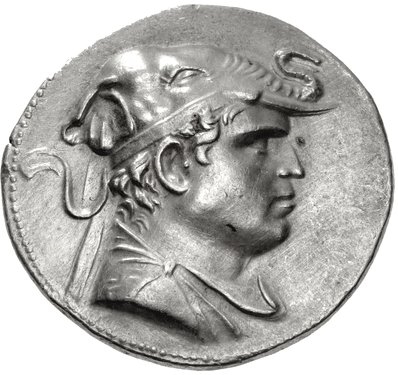 power centers by their own rights. power centers by their own rights.
Indeed, Greek
Bactrian King Demetrius I Aniketos
("the Invincible") would invade India in 180 BC and set up a Bactrian
Greek-Indian kingdom that would last over a century and a half.
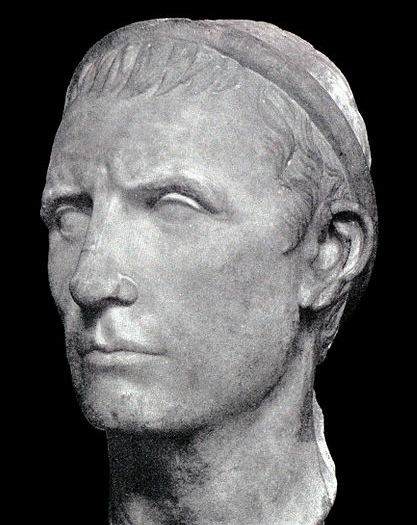 Antiochus III (223-187 BC)
then made the fateful political decision to cooperate with the
Carthaginian General Hannibal – whose army at the time was thrashing
the Romans in their own homeland – in Antiochus's effort to liberate
mainland Greece from Roman influence. That was a mistake.
In four years of fighting between Antiochus's Seleucid army and the
Roman legions, Antiochus was slowly ground down by the Romans, in 188
BC had to accept humiliating terms for peace, and watched the eastern
provinces he had worked so hard to return to Seleucid control once
again go on their independent way. Likewise, he lost land in the
West (Anatolia, today's central Turkey) to Rome's allies Pergamum and
Rhodes. The next year he was killed (assassinated?) raiding
Persia in an attempt to gain the gold he was required to pay Rome as an
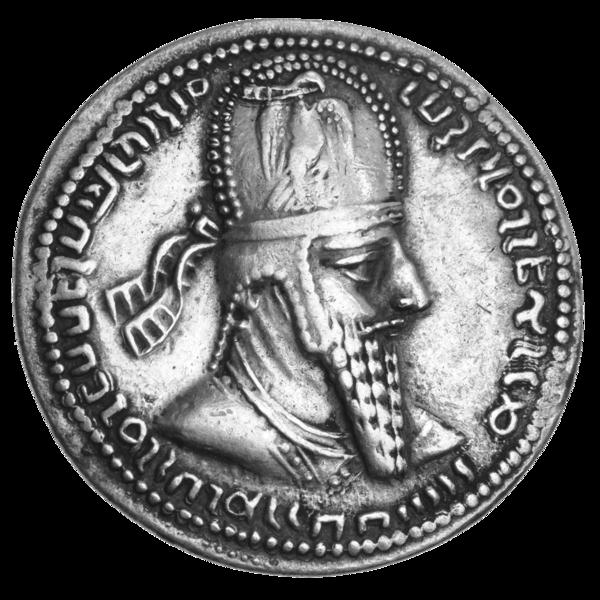
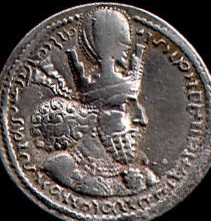
annual indemnity ... at the same time helping to establish Arsacid rule
in Persia in reaction to Antiochus's maneuvering. Antiochus III (223-187 BC)
then made the fateful political decision to cooperate with the
Carthaginian General Hannibal – whose army at the time was thrashing
the Romans in their own homeland – in Antiochus's effort to liberate
mainland Greece from Roman influence. That was a mistake.
In four years of fighting between Antiochus's Seleucid army and the
Roman legions, Antiochus was slowly ground down by the Romans, in 188
BC had to accept humiliating terms for peace, and watched the eastern
provinces he had worked so hard to return to Seleucid control once
again go on their independent way. Likewise, he lost land in the
West (Anatolia, today's central Turkey) to Rome's allies Pergamum and
Rhodes. The next year he was killed (assassinated?) raiding
Persia in an attempt to gain the gold he was required to pay Rome as an
annual indemnity ... at the same time helping to establish Arsacid rule
in Persia in reaction to Antiochus's maneuvering.
Again … Rome. Rome
now pretty much dictated matters ... at least within the Western
reaches of the Seleucid Empire (while the Eastern portions became
increasingly rebellious and independent). Seleucid kings came and went
in rapid succession ... and containing (or causing) civil strife
occupied most of their time in power.
The death of the Seleucid Empire
By
the beginning of the 1st century BC little more than Damascus and the
area of Syria immediately around it was about all that the Seleucids
truly governed ... although they remained deeply involved in the
dynastic politics of the Eastern end of the Mediterranean Sea.
Far greater in power and importance by that time was the Greco Persian
(semi-Seleucid) kingdom of Pontus, to the north of Seleucid Syria ...
and encompassing all of Asia Minor and Anatolia (modern Turkey).
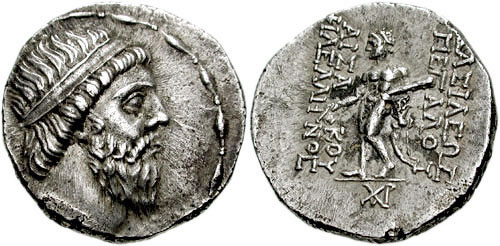
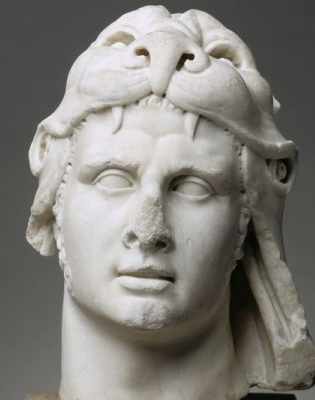 Mithridates VI of Pontus (113-63 BC).
Far greater in power and importance by that time was the Greco-Persian
(semi-Seleucid) kingdom of Pontus, to the north of Seleucid Syria ...
and encompassing all of Asia Minor and Anatolia (modern Turkey) ... in
close alliance with and at times dominance over Armenia – just to
the west of Pontus. Rome was constantly active in trying to bring down
Pontus's leader Mithridates, a very capable military ruler. Wars
between Rome and Pontus were constant ... and in 89 BC Mithridates was
able to defeat an enemy Roman army but also the next year turn on local
Roman and Italian settlers and slaughtered them ... perhaps as
many as 80,000 people. Mithridates VI of Pontus (113-63 BC).
Far greater in power and importance by that time was the Greco-Persian
(semi-Seleucid) kingdom of Pontus, to the north of Seleucid Syria ...
and encompassing all of Asia Minor and Anatolia (modern Turkey) ... in
close alliance with and at times dominance over Armenia – just to
the west of Pontus. Rome was constantly active in trying to bring down
Pontus's leader Mithridates, a very capable military ruler. Wars
between Rome and Pontus were constant ... and in 89 BC Mithridates was
able to defeat an enemy Roman army but also the next year turn on local
Roman and Italian settlers and slaughtered them ... perhaps as
many as 80,000 people.
Finally,
Roman General Pompey took on Mithridates in battle in 66 BC ...
defeating him soundly and sending him into flight. Then in 63 AD,
with Pompey closing in on him – and not wanting him and his family to
be subjected to a triumphal parade in Rome, Mithridates chose
suicide.
Meanwhile
(69 BC) the Romans had resurrected a small portion of the Seleucid
Kingdom for its own political ends ... but after Pompey defeated
Mithridates he redesigned the lands of Eastern Mediterranean into Roman
client states, converting Seleucid Syria into a Roman province under
the rule of a Roman governor.
1It is said that in a battle in 305
BC between the Greek and the Indian generals, Chandragupta was able to
field 600,000 troops and 9,000 elephants.
| 




 Achaemenid Persia of Cyrus (Kurus) The Great (ca. 550 - 530 BC)
 Achaemenid Persia of Darius I The Great (522 - 466 BC)
 Achaemenid Persia of Xerxes
 Alexandrian/Seleucid Persia (ca. 330 -171 BC)
 The Parthian Empire (ca. 171 BC - 224 AD)
 The Sassanid Empire (224 - 651)