|
|
|
by Miles H. Hodges – The Covenant Nation It is so easy to Romanticize
about Revolution. Surely deep change in
a society’s structure – the way it goes at life – is bound to improve
dramatically if the flawed older system is set aside and is replaced with a much
more “rational” system. Such change has
got to lead to some kind of improvement ... dramatically so! Unfortunately,
that is almost never the way things work out historically. And that is because there are a number of
problems with such political logic. Some
examples will make all this quite clear. Take the
French Revolution for example. The
French became important American allies in 1778 in the American colonies’ ongoing
struggle to fight off the tyranny of English King George III. But this was simply because French King Louis
XVI loved the opportunity to undercut the power of his arch-rival, George ... most
certainly not because Louis loved the spirit of independence behind this
American effort. But that was a foolish
thing for Louis to do ... because it presented the French with a political example
that was bound to impact French thinking.
And making the American event even more dramatic to a rising group of
French Idealists was the tendency by the mid-1780s to look back at this American
event no longer as a rebellion but as a “revolution.” Supporting that American effort had actually helped to bankrupt the French treasury. And when an Estates-General or parliament was called in 1789 (for the first time in 175 years!) to offer the King more taxes, these representatives of the French taxpayers demanded political reforms ... deep political reforms. And the American
model was very much on their minds ... and in the terrified thinking of Louis –
who did what he could to stall such reforms.
But this only made matters worse for him. Finally the decision was made by certain
French reformers to end the monarchy ... and then the aristocracy and the
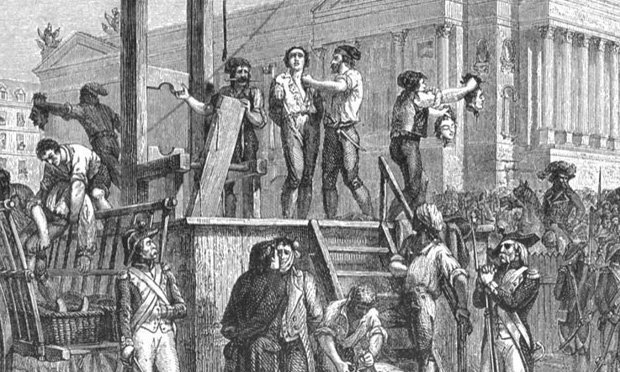
Catholic Church as well. But not all reformers were in agreement on these matters ... so things got even more violent when the two leading reform groups, the Girondins and the Jacobins, turned on each other. By 1794 the slaughter of the “French Revolution” was virtually out of control (the French “Reign of Terror”) ... until these two groups had finally succeeded in eliminating each other.
But this left
the French totally confused. They had no
traditional instincts for self-rule and thus their efforts to put in place
something that looked like the American Republic led to rather uninspiring
results. It finally took the clever move
of Napoleon to deflect all this awakened French energy abroad, against France’s
rival powers (Italy, Spain, the Germanic states, Poland, Russia, etc.) ... and
take over French society as its “Emperor.”
And so the French Revolution went.
It took a dictator to bring things politically back to normal in France. This spirit of
Revolution would shake the rest of Europe in the 1800s as other societies
attempted to shake off the feudal system they had lived under since time
immemorial. And things certainly were
changing ... especially in the world of economics where indeed an Industrial
Revolution was well underway – changing deeply the way Westerners now took on
life. Karl Marx saw
this as an opportunity in the mid-1800s to bring things to a revolution in the
world of politics as well ... presuming a natural instinct of industrial
workers to rise up in revolution against their capitalist industry owners and
build a workers’ democracy to replace the growing capitalist system. However, he died before he had a chance to
see such a glorious revolution take place.
But he left a strong legacy ... one taken up in Russia by Lenin and his
Communists. With Russia bleeding itself
to death in a pointless world war (World War I – 1914-1918), Lenin was able in
late 1917 to achieve something similar to what the French had done with their
Revolution over a century earlier: end
the monarchy, aristocracy and church ... and replace it with a system of
workers’ councils (soviets) to govern “revolutionary” Russia. But reality meant that such “democracy” was
going to have to be directed from above (like revolutionary France) ...
supposedly only temporarily. But all
that really developed was that Russia (like France) fell into a horrible civil
war ... one that killed millions of Russians.
And Russia (like France) was only restored to some kind of order when it
was brought under dictatorship. So, all
Russia got out of its “revolution” was the incredibly cruel dictatorship of
Joseph Stalin. I could go on
and on about these kinds of events. But
my point ultimately is that America needs to stay out of the business of
exporting “revolution” to other societies ... when we try to topple their
existing regimes with the expectation that his would bring them automatically to
democracy. Democracy is not planted from
above ... but is found only in well-planted social instincts of the people
themselves. Without those instincts, bloody
chaos will be only the result. Look at
Vietnam. Or how about Iraq? Our bloody intervention in Iraq merely
transferred power from the Muslim Sunnis to their arch-rivals the Muslim
Shi’ites. This was not the beautiful
pro-Western democracy that Bush, Jr. presumed would be the result. And the same for our involvement in Libya and
Syria under Obama. All we succeeded in
doing was helping to increase the slaughter involved in the social breakdown of
these societies – and sending millions of individuals into refugee camps or
across European borders in the hope of escaping this slaughter. Miles Hodges is a writer,
historian and political analyst who explores the question of why societies behave
as they do ... especially in this matter of their rise and fall. |