|
|
|
by Miles H. Hodges – The Covenant Nation I love the term “Middle America.” It means so much to me ... probably because I was born and raised in just such a social setting. Middle America is the America belonging to neither the very rich nor the very poor. I found it easy to be part of a system that does not try to build itself into some kind of overpoweringly rich social phenomenon, but contents itself with the simple but wonderful securities of home, job and family. And I don’t mean to be anti-poverty either in my designating Middle America as not being part of the world of the very poor. It’s just that in the world that I grew up in, “poor” would have been a state of mind that I never found to exist in my small-town world.
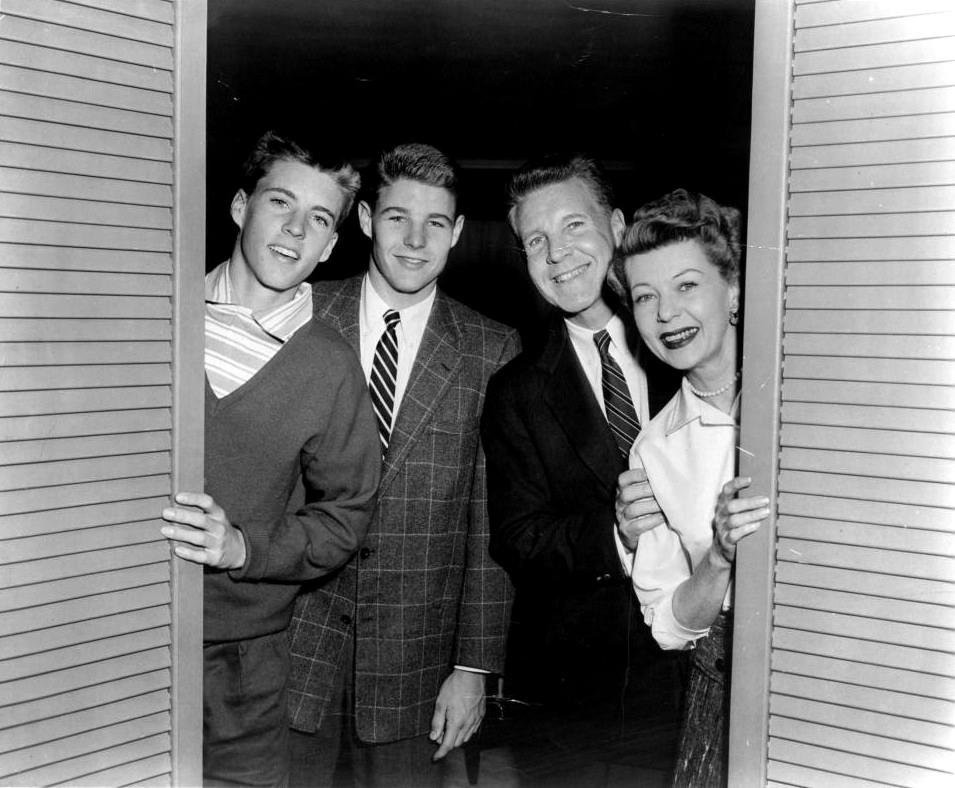
The 1950s Ozzie and Harriet TV show was based on the Middle American lifestyle ... portraying its challanges and celebrating its virtures To be sure, I was not indifferent to the poor ... found mostly in some of the larger cities around us. I myself eventually served years trying to support and give hope to countless “street people” ... jobless, family-less, and fairly hopeless. And with respect to the last-mentioned, hopelessness, I did my best to try to show them ways to such hope. And they loved me for it. But it was an almost impossible task. I was well aware of the challenges facing them in their struggles in life. In the inner city no one owned their own
homes but rented apartments (if they could afford them). Jobs were available ... but just for those
possessing the skills needed for office jobs ... for which my barely literate
street guys were in no ways qualified.
Of course there were manual labor jobs available – though not many. But even these required a certain work-ethic
or discipline that my street guys did not possess ... because they had not been
brought up in a world of social discipline.
By and large, they never knew their fathers. And in many cases their mothers were strung
out on drugs that public welfare gave them the means to purchase. No ... this was definitely not Middle
America. But most
ironically, all of this helped me come to an even deeper understanding of
Middle America, how it is built and why it is so important to America. In my Middle America, of greatest importance I
realized was the family − with father, mother and children living together in a
quite positive environment. The father
played the role that all males in the mammal kingdom play, that of protector of
the family unit. And through his job in
the community work force, he was also the financial provider, able through his
own earnings to give the family all the economic support it needed to live
comfortably. The mother was given the
all-critical task of birthing their children, nursing them to health and then
supervising their early development ... at least until they headed off to
school to continue the learning process.
And she prepared the meals, cleaned the laundry and house itself, to
assure a high degree of presentable order to the family. Then with all the kids in school, she could
become more active in community affairs ... helping to keep the family in close
harmony with the larger social world.
And then there was church ... Sunday mornings devoted to Sunday school and
then church worship ... and probably youth and adult Christian fellowship that
same evening. And afternoon Sunday meals
were presented as a special family occasion ... with the fanciest meals
prepared in celebration of the family’s togetherness. Then there would be higher education for some, although a high school education generally sufficed to ready America’s youths to step into their own family world ... complete with marriage, job, purchase of a house, the birthing of a new generation, etc. And so Middle America moved ahead, everyone quite structured ... but also quite sovereign in how that life was designed by the American “commoners” themselves ... not by some presiding political authority. So what
happened to Middle America? That is
clearly not the dominant American social scene today. This is not yet the time or place for me to
go into detail as to what happened. But I
can summarize things in pointing out that deep social changes – a social
“revolution” actually – hit America deeply in the 1960s, beginning a process by
which Middle America was purposely disassembled because it did not conform to a
whole new set of social ideals. A
rapidly rising spirit of feminism tended to portray marriage as being something
of a male-dominated trap ... a trap that women needed to be freed from so that
they could follow their own professional careers outside the home. And a welfare program was also designed at
that time to help the poor (especially if they were Black) ... which succeeded
not in lifting people out of their poverty, but instead keeping them there,
dependent on the trickle of funds sent by the government to poor “families” ...
provided that no employable male was present in that family institution. Thus for multiple reasons, marriage as an
institution broke down, an increasing number of children were raised
fatherless, and other activities that would never have been thought to be a
good way of going at life now became not only acceptable, but beyond criticism
(criticism now even punishable under the new laws). But
interestingly, some 50 years after this social “revolution,” a large
number of
America’s youth (Gen-Z) are making personal decisions to try to get
their lives
back in line with America’s long-standing Middle America program.
Let’s hope they succeed. It was, after all, Middle America
that
brought America to success – becoming even a superpower − by the
beginning of
the 1960s ... just prior to this disastrous social-moral
“revolution.” And it is only by once again going down the
road of “Middle America” that there is any hope of our society being
able to stop
the downward trend of any society that forgets what it was that brought
it to
greatness. As history reveals
repeatedly, foolishly taking on new, untested social ways inevitably
produces
moral-spiritual confusion ... which in turn produces social, economic
and
political confusion – the kind that America finds itself caught in
today. So ... Gen-Z, I’m with you all the way. Bring us
back to the true social greatness
found in Middle American life! That is, after all, exactly how God
himself
wanted to see us Americans go at life. Miles Hodges is a writer,
historian and political analyst who explores the question of why societies behave
as they do ... especially in this matter of their rise and fall. |